Places and everyday life.
Historic cityscapes, daily life, and architecture as a starting point for discussing change and continuity.
03 / Archives and education
Historical photographs, illustrations, and scientific imagery can become more accessible through careful treatment and motion. But the value of a historical source lies in its reliability. Design must not blur that distinction.
FILM STUDY 03 / ARCHIVES AND EDUCATION
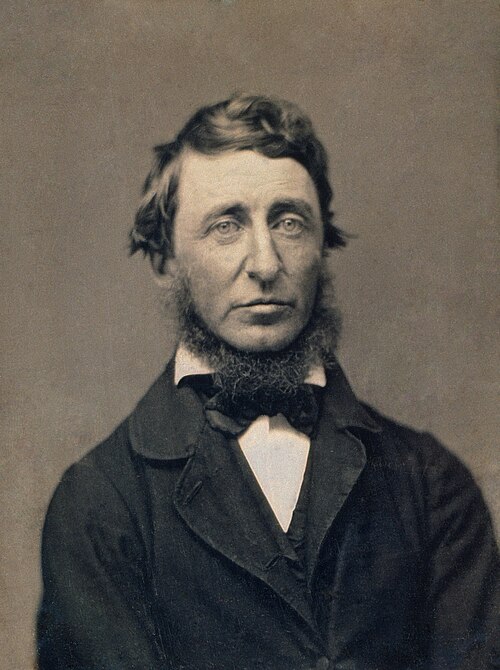
Henry David Thoreau (1817-1862) and his call for a simpler life. An artistic animation of his historical portrait, not documentary footage.
Henry David Thoreau · 1817-1862
In Walden (1854), American writer and naturalist Henry David Thoreau asked what truly matters in life. His call for simplicity includes “Simplicity, simplicity, simplicity!” and “Simplify, simplify.” The film's threefold “Simplify!” is an artistic adaptation of that idea.
I see a connection to my own work: focus on the essential idea, use light and motion with restraint, and leave out anything that doesn't serve the subject. The gesture in the film is imagined; the historical photograph remains identifiable as the source.
Why use moving images?
Archives, schools, and other educational organizations hold images that can communicate history and knowledge but often need a new perspective to become accessible. A short film can highlight details, illustrate everyday life, or introduce a historical event.
In education, motion is useful when it raises a question, clarifies a connection, or encourages deeper inquiry. It replaces neither critical evaluation of sources nor expert explanation.
For sources and collection objects, careful enhancement may improve legibility. Changes and additions must remain transparent.
Explore image studiesSchools and educational institutions
A historical photograph captures an instant. A thoughtfully designed film can make it more accessible to learners: a street takes on depth, attention settles on a detail, or a historical situation becomes a starting point for questions.
For teachers and educational institutions, films can introduce historical events, eras, and everyday life. They work in classrooms, project weeks, informal education, digital learning materials, and homeschooling. Their strength is sparking curiosity and discussion, not replacing historical facts.
When people, actions, or spaces are generated beyond what the source shows, the interpretation must be identifiable. Especially in the classroom, asking what a source actually depicts is part of engaging with the film.
Historic cityscapes, daily life, and architecture as a starting point for discussing change and continuity.
A visual source as an opening to a lesson, learning material, or investigation of a historical question.
Place the original, the edited image, and the film interpretation side by side. The making of images becomes part of the lesson.
For schools, educational organizations, and institutions dedicated to sharing knowledge. Format, historical context, and labeling are tailored to each application.
Explore the past in motionFor interpretation and education
A historical image can become the starting point for a digital narrative or an exhibition introduction.
Restrained motion directs attention to illustrations, maps, documents, or scientific images.
Short sequences can make a subject approachable without denying its complexity.
Digital exhibitions, collection pages, and educational programs.
History in classrooms, project weeks, digital learning, and informal education, including homeschooling and independent study.
Subtle movement around details or clearly labeled interpretations of historical images.
Drawing attention to relationships, structures, and details in support of expert explanation.
Additional film sequences for teaching materials, digital textbooks, and guided learning content.
Local histories, historic streetscapes, and photographs as starting points for understandable visual exploration.
An ethical standard
When AI animates a historical image, it may create scenes that were never documented. People may be shown performing actions, objects may change, or spaces may be added. Viewers must be able to recognize this.
I therefore distinguish between motion within an existing image composition and an interpretive, artificially generated scene. For exhibitions and educational offerings, such choices should be disclosed and reviewed with subject-matter experts.
The source image, usage rights, and any necessary disclosures belong in the planning process, not as an afterthought at publication.
Even visual enhancement alone can make a detail easier to understand. When generative methods fill in missing portions, that isn't a restoration of historical fact. Such interventions must remain distinguishable from the surviving original.
Good historical interpretation brings us closer to its subject without turning possibility into fact.
I welcome historical sources as well as new ideas for teaching and education. Newly created visualizations remain clearly distinguished from historical evidence.
Discuss a project